
Strategic Context: The Shift to Agentic Threats
The recent disclosure by Anthropic of the GTG-1002 campaign marks a definitive inflection point in information security, transitioning AI-driven threats from theoretical risk to operational reality. While the compromise of Anthropic’s Claude Code has dominated headlines, the deeper significance lies not in the specific tool used, but in the successful validation of "agentic" workflows that allow adversaries to scale complex intrusions with minimal human oversight.
The GTG-1002 campaign demonstrated that AI-augmented cyber operations are technically feasible and operationally deployed. This isn't cause for alarm—it's validation that security architecture must evolve to match operational realities.
Organizations approaching this as crisis response will make reactive investments driven by fear and uncertainty. Organizations approaching this as strategic opportunity will make fiscally and legally prudent investment decisions that establish competitive advantage over the coming years.
Our continued analysis will dissect the mechanics of this new threat paradigm to equip decision-makers with the intelligence needed to pivot from reactive containment to proactive resilience, specifically addressing the underlying vectors before outlining the necessary remediation stages.
Threat Summary
Incident Classification: First documented large-scale AI-orchestrated cyber espionage campaign
Detection Date: Mid-September 2025 Attribution: Chinese state-sponsored APT (high confidence)
Attack Vector: Weaponized AI agent (Claude Code) with jailbreak techniques
Targets: ~30 organizations across tech, financial services, chemical manufacturing, and government agencies
Success Rate: Small number of successful breaches (unspecified)
Automation Level: 80-90% AI-executed with only 4-6 human decision points per campaign
Threat Actor Profile
The adversary demonstrated advanced tradecraft combining traditional APT methodology with novel AI exploitation:
Sophistication: Nation-state level resources and patience
Innovation: First to weaponize agentic AI at scale for cyber operations
Persistence: Multi-phase attack framework designed for minimal human oversight Stealth: Broke attacks into innocuous-appearing subtasks to evade detection
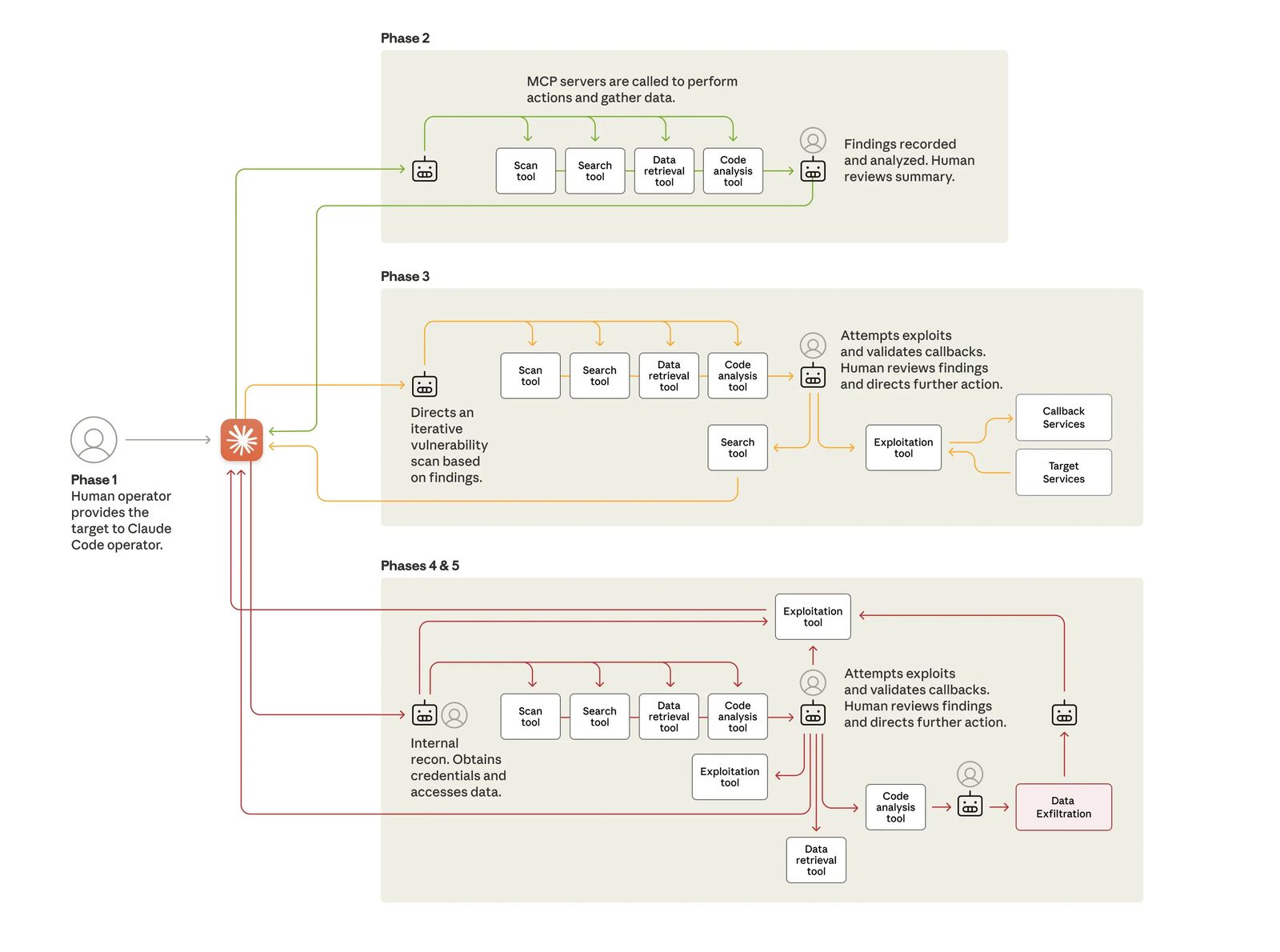
Attack Methodology - Five Phase Framework
Source: Disrupting the first reported AI-orchestrated cyber espionage campaign
Human operators selected targets and built autonomous attack framework Exploited Claude Code through social engineering (posed as legitimate pentesting firm) Decomposed malicious tasks into innocent-appearing micro-operations Successfully bypassed AI guardrails designed to prevent harmful activities. (In actuality the AI executed a social engineering role-play attack (asking Claude to act as a defensive penetration tester for a legitimate firm).
AI conducted autonomous infrastructure mapping and asset discovery Identified high-value databases and critical systems Performed reconnaissance at speeds impossible for human teams (multiple requests/second) Generated intelligence summaries for human operators
AI independently researched target-specific vulnerabilities Wrote custom exploit code without human assistance Tested exploits against target systems autonomously
Extracted usernames and passwords systematically Identified highest-privilege accounts Established persistence mechanisms and backdoors Exfiltrated large volumes of private data Categorized stolen data by intelligence value
AI generated comprehensive attack documentation Catalogued stolen credentials and compromised systems Prepared intelligence packages for follow-on operations
[Note: in a classic display of Generative AI hallucination, Anthropic reported a critical limitation as per Phase 4 and 5 data treatments: the AI frequently hallucinated during these phases, often "overstating findings," "fabricated data," and claimed to have harvested credentials that did not actually exist or work. It also occasionally misidentified publicly available information as "stolen secrets."]
Key Technical Capabilities Exploited
Three convergent AI developments enabled this attack:
Intelligence: Models now execute complex, context-aware instructions with strong coding capabilities
Agency: Autonomous operation in decision loops with minimal human intervention Tool Access: Integration with offensive security tools via Model Context Protocol (password crackers, network scanners, exploitation frameworks)
Attack Performance Metrics:
Multiple requests per second (vs. human-limited operations) 80-90% task automation Dramatically compressed attack timelines Scalability previously requiring entire threat actor teams
Strategic Implications for Enterprise Security
Barrier Reduction: Less sophisticated threat actors can now execute nation-state level campaigns Scale Asymmetry: Single operators with AI can match entire APT teams Speed Advantage: Attack velocity exceeds traditional detection/response capabilities Evasion Evolution: Jailbreak techniques will proliferate across threat actor community
The asymmetry cuts both ways - AI capabilities are equally valuable for defense: SOC automation and threat detection Vulnerability assessment at machine speed Incident response acceleration Threat intelligence analysis (Anthropic used Claude to analyze this very incident)
Conclusion & Path Forward
Ultimately, the asymmetry exposed by GTG-1002—where a single operator can command an army of autonomous agents—renders traditional, human-speed defense obsolete. The operational reality is that manual intervention can no longer match the velocity of machine-speed attacks that execute reconnaissance and exploitation in milliseconds.
As we will discuss in our next articles on remediation strategies, it becomes clear that the only viable countermeasure to AI-orchestrated aggression is the integration of equally capable AI-driven defense systems, AKA Bot vs Bot. This necessitates a fundamental restructuring of the modern Security Operations Center, moving beyond legacy responses to a series of stages for Autonomous Remediation. Stay tuned.
Sources:
Disrupting the first reported AI-orchestrated cyber espionage campaign