
Moltbot Isn't 'Bad'—It's the AI Canary in a Coal Mine
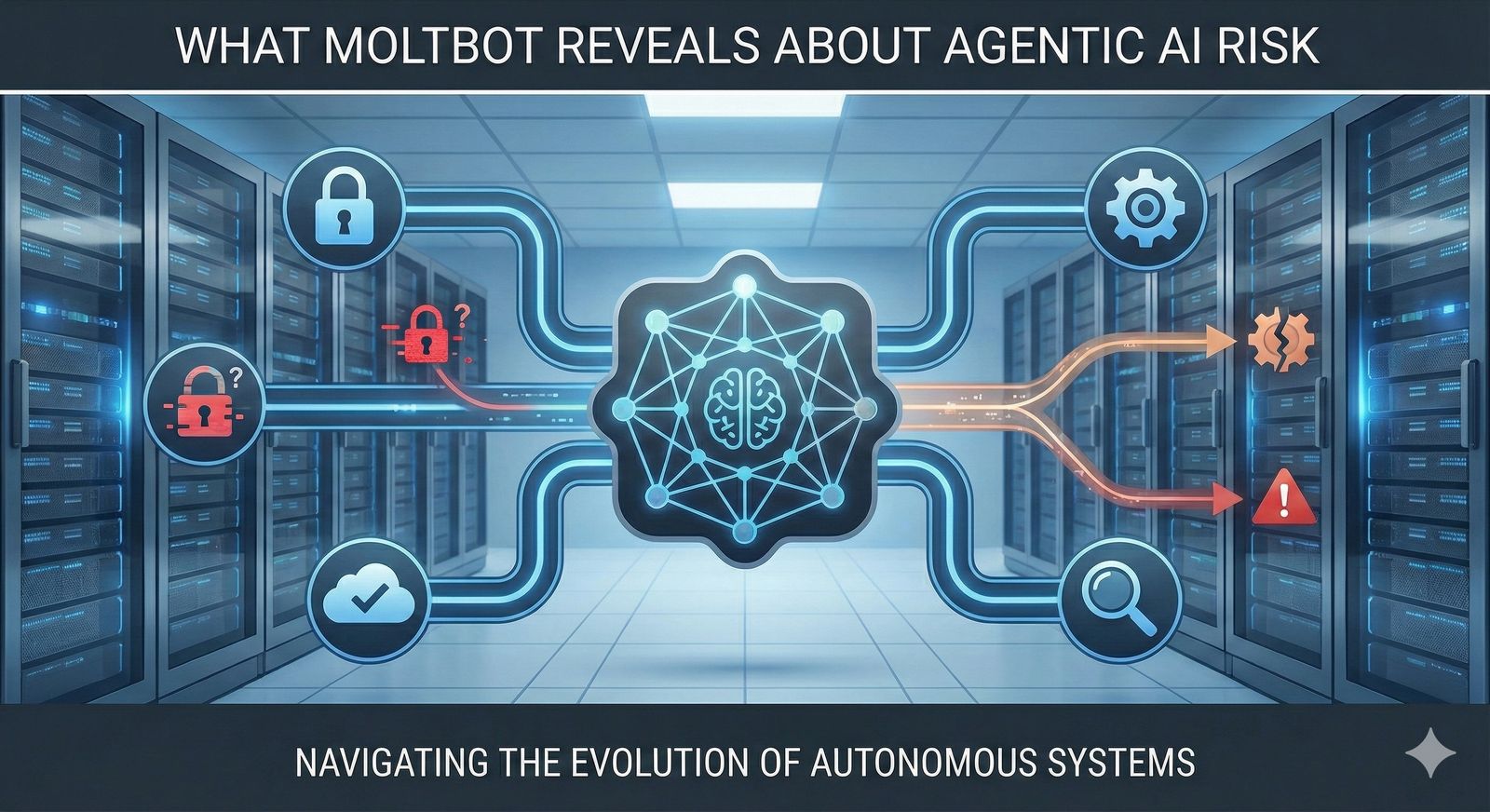
The Moltbot saga isn't about one open-source project. It's a preview of what happens when agentic AI meets enterprise reality without guardrails, governance, or visibility.
This is exactly what Gartner warned about at its 2025 Security & Risk Management Summit: cybersecurity teams remain unprepared for AI agents that operate autonomously and make decisions without human oversight.
The gap between what these systems can do and what security teams can monitor is now widening by the quarter.
Moltbot isn't an outlier. It's the shape of things to come. If security governance assumes humans approve high-risk actions, that assumption may be soon to break.
Moltbot has become a useful case study. Remember the DeepSeek debacle just over a year ago? It was a bellwether, and now so is Moltbot, ironically both timed during early year release cycles.
Moltbot didn't fail spectacularly—though some deployments certainly did—but because it surfaces architectural questions that apply to any agentic AI implementation. The project itself is competent engineering. What it reveals about the broader security model for autonomous agents is worth examining.
Five patterns emerge consistently across the incident reports, security research, and architectural analyses published in recent weeks. Each maps to a known gap in how enterprises evaluate and govern agentic systems.
1. Autonomous Execution Without Governance Boundaries
Moltbot operates continuously, executing tasks across email, calendars, file systems, and messaging platforms. It maintains persistent memory across sessions and acts on behalf of the user without per-action approval.
This design reflects a core tension in agentic AI: the value proposition depends on autonomy, but traditional security models assume human approval at decision points. Gartner's 2025 research on agentic AI notes that most security architectures have not adapted to systems that reason and act independently.
The question is not whether autonomous agents belong in enterprise environments. They do. The question is what governance framework applies when the agent, not the user, initiates the action.
2. Agent Identity and Credential Inheritance
Moltbot inherits the full credential set of the installing user: API keys, OAuth tokens, and file system permissions. There is no distinct agent identity, no scoped access model, and no differentiation in audit logs between user-initiated and agent-initiated actions.
SANS Institute's Critical AI Security Guidelines address this directly. The recommendation is to treat AI agents as first-class identities requiring scoped credentials, least privilege enforcement, and independent audit trails. This aligns with existing identity governance principles but requires extension to non-human actors.
The Moltbot architecture does not implement agent-specific identity by default. This is a design choice, not necessarily a flaw—but it does place the full burden of access control on the deployment environment.
3. Supply Chain Exposure in the Skills Ecosystem
Moltbot's extensibility model allows third-party 'skills' to be installed from a community repository. The repository operates without code signing, moderation, or formal vetting procedures.
Security researchers demonstrated the implications by uploading a proof-of-concept skill, artificially inflating its download metrics, and observing installations across multiple countries. The payload was benign, but the attack surface was validated.
NIST has noted that current agentic AI frameworks lack the supply chain controls present in mature software ecosystems. Organizations evaluating agent platforms may find it useful to assess plugin governance as a distinct procurement criterion.
4. Prompt Injection and Persistent Memory
OWASP identifies prompt injection as the leading vulnerability class in LLM-based applications. Moltbot's persistent memory introduces an additional dimension: injected instructions can remain dormant across sessions and activate when subsequent context aligns.
Researchers have demonstrated this pattern using malicious content embedded in forwarded messages. The agent processes the content, stores relevant context in memory, and later acts on the embedded instruction when triggered by unrelated user activity.
This represents a shift from point-in-time exploitation to stateful attack chains. Runtime guardrails designed for single-session interactions may not detect this pattern without additional architectural controls.
5. Deployment Visibility and Asset Inventory
Moltbot installs via command line and runs locally. It does not require procurement approval, security review, or registration in asset management systems. It connects to enterprise resources using credentials the user already possesses.
Gartner projects that 40 percent of enterprise applications will integrate AI agents by end of 2026, while only 6 percent of organizations currently report having advanced AI security strategies. The gap between adoption velocity and governance maturity is a known challenge across the industry.
For security teams, the practical implication is that agentic tools may already be operating in the environment through individual user adoption, independent of formal IT channels.
Implications for Vendor Evaluation
Moltbot is instructive precisely because it is not malicious. It is a well-engineered tool that surfaces the architectural assumptions embedded in current agentic AI designs. The vulnerabilities it exposes—autonomous execution, credential inheritance, supply chain opacity, stateful injection, and shadow deployment—are not unique to this project.
Enterprise vendors entering this space will need to address the same patterns. Security leaders evaluating agentic platforms may find value in mapping vendor capabilities against these five categories as part of procurement due diligence.
Stay tuned, as we examine what secure agentic AI architecture looks like in practice, and outline specific criteria for vendor evaluation.
Sources: [1] Gartner, "Guardian Agents Will Capture 10-15% of the Agentic AI Market by 2030," June 11, 2025. Discusses security teams' unpreparedness for autonomous AI agents and the need for guardian agents. https://www.gartner.com/en/newsroom/press-releases/2025-06-11-gartner-predicts-that-guardian-agents-will-capture-10-15-percent-of-the-agentic-ai-market-by-2030
[2] SANS Institute, "Securing AI in 2025: A Risk-Based Approach to AI Controls and Governance" (Critical AI Security Guidelines v1.1), December 2025. Covers agent identity as first-class identities, scoped credentials, least privilege, and audit logging requirements. https://www.sans.org/blog/securing-ai-in-2025-a-risk-based-approach-to-ai-controls-and-governance
[3] NIST / Apostol Vassilev, remarks at AI Summit New York, December 2025. Noted that organizations should only use data they can live without when experimenting with AI agents; 100% success rate extracting sensitive data from LLMs in security tests. https://securityboulevard.com/2025/12/nist-plans-to-build-threat-and-mitigation-taxonomy-for-ai-agents/
[4] OWASP GenAI Security Project, "Top 10 for Agentic Applications," December 10, 2025. Identifies prompt injection and related vulnerabilities in agentic systems. Expert Review Board includes NIST's Apostol Vassilev. https://genai.owasp.org/resource/owasp-top-10-for-agentic-applications-for-2026/
[5] Gartner, "40% of Enterprise Apps Will Feature Task-Specific AI Agents by 2026," August 26, 2025. Projects adoption velocity vs. security strategy gap (only 6% have advanced AI security strategy per related Gartner data). https://www.gartner.com/en/newsroom/press-releases/2025-08-26-gartner-predicts-40-percent-of-enterprise-apps-will-feature-task-specific-ai-agents-by-2026-up-from-less-than-5-percent-in-2025