
Five Barriers Between AI and Your Network Security Stack — And Where They're Eroding
KEY TAKEAWAYS
- AI can understand data exfiltration, business logic abuse, and social engineering at a semantic level no signature engine matches. The capability gap is real.
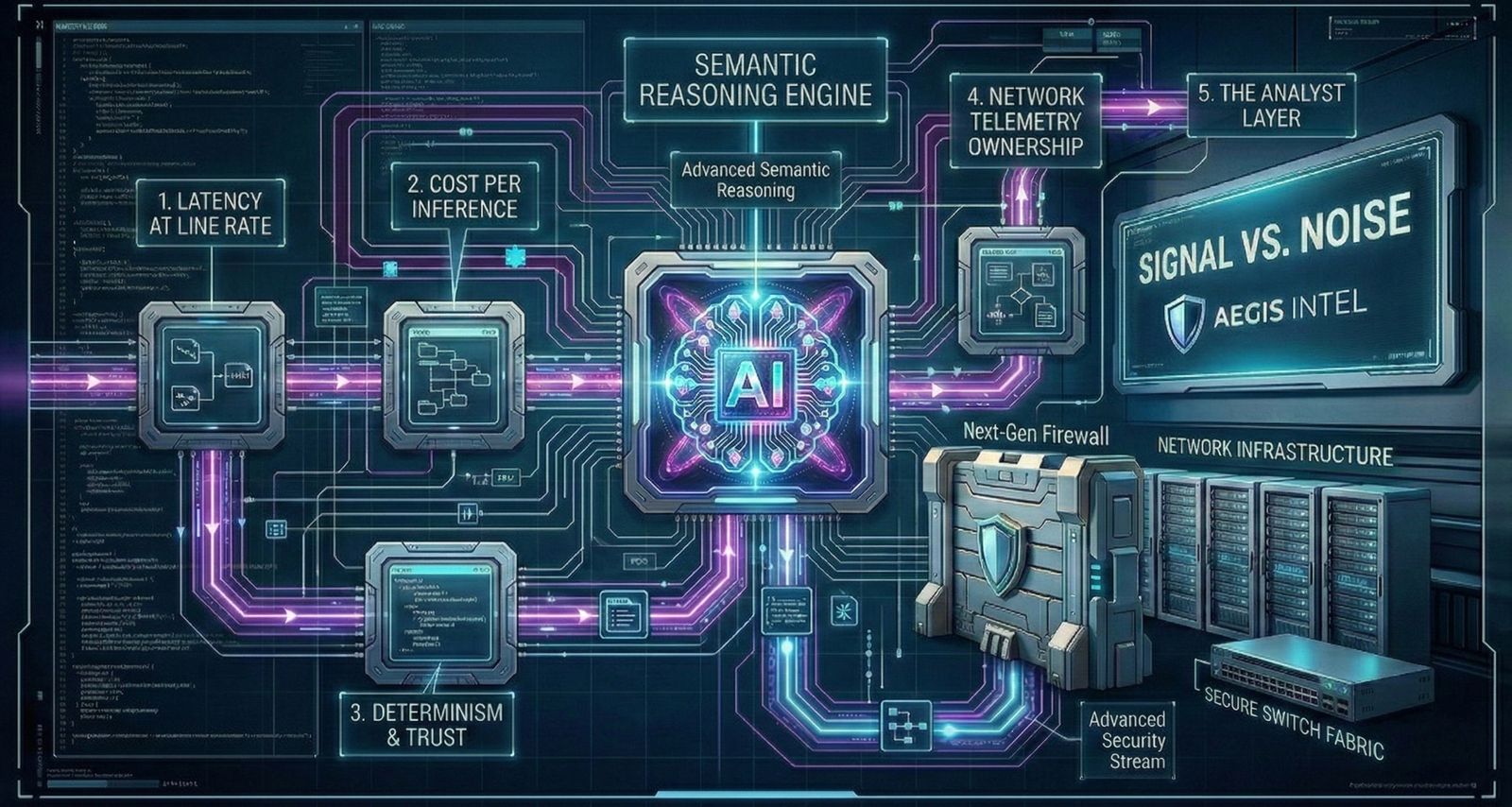
- Five architectural barriers — line-rate latency, inference cost at scale, deterministic enforcement requirements, telemetry ownership, and analyst layer economics — prevent that capability from replacing network security infrastructure today.
- Not all five barriers are equal. Latency, cost, and determinism are hardening. Telemetry control is shifting toward a federated model. The analyst layer is already compressing.
- The emerging architecture is two-tier: deterministic enforcement at the edge, AI reasoning on flagged traffic above it. That structure makes telemetry sources more valuable, not less.
- Security leaders should evaluate which barriers each vendor in their stack actually depends on — and whether those specific barriers are strengthening or weakening on procurement-relevant timelines.
We have entered an era where security infrastructure is no longer blind to context. For the first time in the cybersecurity industry, enterprise defense mechanisms are crossing the threshold from merely recognizing patterns to actively understanding intent.
An AI foundation model can read an outbound data payload and recognize that it contains a reformatted customer database disguised as a routine API response — not because it matches a signature, but because it understands what the data means. It can identify that a sequence of individually legitimate API calls constitutes an unauthorized funds transfer by reasoning about business logic. It can detect social engineering in a Slack message containing no malicious URL, because it understands adversarial intent at the semantic layer.
No network security tool on the market can do any of this. And the AI that can do it cannot sit in the network path where it would need to operate.
That tension defines cybersecurity AI in 2026. The capability is real. The deployment architecture is not. Five barriers explain why — and whether each is permanent matters for how security leaders evaluate their vendor stack.
Firewalls process millions of packets per second at microsecond latency on custom ASICs built for throughput. LLM inference runs at 200 milliseconds to two seconds per request. This is not an optimization problem. It is a fundamental mismatch between transformer inference and line-rate packet processing. The constraint is physics.
- Assessment: Durable. Specialized small models on inference silicon may narrow this toward 2027–2028. Production enforcement at line rate remains beyond the current horizon.
The standard enterprise generates billions of network events daily. Palo Alto Networks documents an average firewall log at 1,500 bytes — roughly 375 input tokens before system prompt overhead or contextual framing. A mid-size enterprise generating 5,000 events per second produces over 430 million tokenizable events per day. At the cheapest available model pricing, input tokenization alone for a single telemetry stream exceeds $30,000 daily — an annual cost that rivals the entire security program budget before a single output token is generated. Scale that to a large enterprise at 25,000 EPS across multiple telemetry sources, and the arithmetic becomes indefensible.
Processing every flow through a reasoning model is economically prohibitive at any foreseeable price point. This is the constraint shaping the emerging consensus: deterministic enforcement at the edge handling volume, AI reasoning as a second-pass layer on flagged traffic and ambiguous patterns. Processing every flow through a reasoning model is economically prohibitive at any foreseeable price point. If rule-based enforcement passes only the anomalous 1% of flagged packets to the reasoning layer, the same mid-size enterprise drops from 430 million events to 4.3 million — a tokenization cost that falls within enterprise procurement range. At these economies of scale, the two-tier architecture starts to look less like an architectural preference and more like a procurement constraint.
- Assessment: Persistent at full scale. Declining inference costs make the second-pass architecture viable, changing staffing models without changing the enforcement layer.
When a firewall blocks a packet, the rule is logged, traceable, and auditable. LLM outputs are probabilistic. A 0.1% misclassification rate sounds acceptable — at enterprise scale it means thousands of false blocks daily. No CIO or CISO will deploy a probabilistic engine in the critical path, and regulators will not certify one. This barrier runs on institutional timelines, not model release cycles. Machine speed inference doesn't jump the chasm here.
- Assessment: More likely to strengthen than erode.
This barrier is the most structurally nuanced of the five — and the most frequently misread by the market.
Platform vendors that collect telemetry own the data that makes AI reasoning valuable. CrowdStrike's Threat Graph processes trillions of events per day across a data asset built since 2013. Palo Alto's Cortex Data Lake ingests network, endpoint, and cloud telemetry into a unified store. These are compounding data flywheels: every new customer adds sensors, every sensor enriches the dataset, and the enriched dataset improves detection for all customers. A foundation model without access to this telemetry is a reasoning capability with nothing to reason over.
Even if counterintuitive, the implication is that AI makes telemetry sources more valuable, not less. As reasoning engines improve, the premium on high-fidelity, real-time data increases. The firewall generating structured packet logs, the endpoint agent capturing behavioral events, the cloud connector surfacing configuration drift — these become the indispensable fuel layer for every AI-driven analysis capability built above them. The vendor that owns the sensor owns the leverage.
Where the barrier is shifting is not in collection but in control over interpretation. The Arctic Wolf–Anthropic partnership is instructive: Arctic Wolf processes over eight trillion security events per week across its Aurora Platform and provides the telemetry, while Anthropic supplies the reasoning engine via its LLM. Neither displaces the other — but the partnership demonstrates that exclusive insight extraction from proprietary telemetry is no longer guaranteed. This is directional for this market segment. Call this the Federated State for AI Cybersecurity. As integration protocols like MCP mature and telemetry becomes more portable, the competitive question shifts from "who collected the data" to "who reasons over it most effectively."
Vendors that restrict telemetry mobility through proprietary formats or punitive data egress pricing are betting on a lock-in strategy. Vendors that treat telemetry liquidity as a feature are positioning for the architecture that is actually forming.
- Assessment: The collection layer remains durable and is strengthening. Exclusive control over insight derived from it is eroding as reasoning layers become interchangeable and integration standards commoditize the analytical access point. The Federated Standard Model should control market direction for the near to mid-term
- The collection layer remains durable and is strengthening. Exclusive control over insight derived from it is eroding as reasoning layers become interchangeable and integration standards commoditize the analytical access point.
- The Federated Standard Model should control market direction for the near to mid-term
This barrier has already fallen. Alert triage, context enrichment, escalation logic, and Tier 1 SOC workflows are precisely what AI reasoning handles well. Every major platform vendor is embedding these into their premium enterprise tiers — evidenced by Charlotte AI, Purple AI, Security Copilot, and XSIAM. Managed detection providers whose margin depends on analyst labor arbitrage face structural compression.
Downstream, standalone SIEMs face similar pressure, though not because LLMs are replacing their ingestion engines. The tokenization costs and latency of feeding a raw 50,000 Event Per Second (EPS) firehose directly into an LLM are prohibitive. Instead, enterprises are migrating raw logs into low-cost security data lakes. When a basic, low-latency compute rule flags an anomaly, the reasoning engine uses protocols like MCP to dynamically query the data lake, retrieve the surrounding context, and perform the correlation natively. The legacy SIEM platform — which existed primarily to provide a user interface for human analysts to correlate logs — loses its commercial justification the moment an API can do the querying.
- Assessment: Compression underway and should accelerate.
WHERE THIS LEAVES SECURITY LEADERS
The barriers between AI and network enforcement are real, architectural, and predominantly durable. The barriers between AI and the analytical layer above it are largely gone.
The practical outcome is a Federated, two-tier architecture already forming across the industry: deterministic enforcement at the edge, AI reasoning as the intelligence layer above it. That model reinforces platform vendors who own both the enforcement engine and the telemetry — and pressures everyone positioned between platform and customer whose value was interpretive rather than structural.
Prospectively, the vendors building toward both tiers warrant confidence. The ones whose moat was the analyst layer that AI just repriced warrant scrutiny.
-- Signal vs. Noise is the Aegis Intel analysis series examining AI's structural impact on enterprise cybersecurity. Each installment separates durable insight from market noise. Previous installments at aegisintel.ai.
Sources
- Palo Alto Networks — Logging Service Sizing, knowledgebase.paloaltonetworks.com/KCSArticleDetail?id=kA10g000000ClVMCA0
- Anthropic — API Pricing, Feb 2026, platform.claude.com/docs/en/about-claude/pricing
- Anthropic — "Zero-Days," Feb 5, 2026, red.anthropic.com/2026/zero-days/
- Anthropic — "AI for Cyber Defenders," Sept 2025, anthropic.com/research/building-ai-cyber-defenders
- Cybench Framework — cybench.github.io
- CrowdStrike — Threat Graph Data Sheet, crowdstrike.com/en-us/platform/threat-graph/
- CrowdStrike — "How LSM Trees Enable Trillions of Events per Day," Jan 2025, crowdstrike.com/en-us/blog/how-log-structured-merge-trees-enable-crowdstrike-to-process-trillions-of-events-per-day/
- Arctic Wolf — "Anthropic Partnership for Next-Gen Autonomous SOC," April 28, 2025, arcticwolf.com/resources/press-releases/arctic-wolf-and-anthropic-to-advance-rd-for-next-generation-autonomous-soc/
- NIST SP 800-41 Rev. 1 — csrc.nist.gov/pubs/sp/800/41/r1/final