
Project Glasswing: If Mythos Is Real, What Breaks First?
Is Mythos Real?
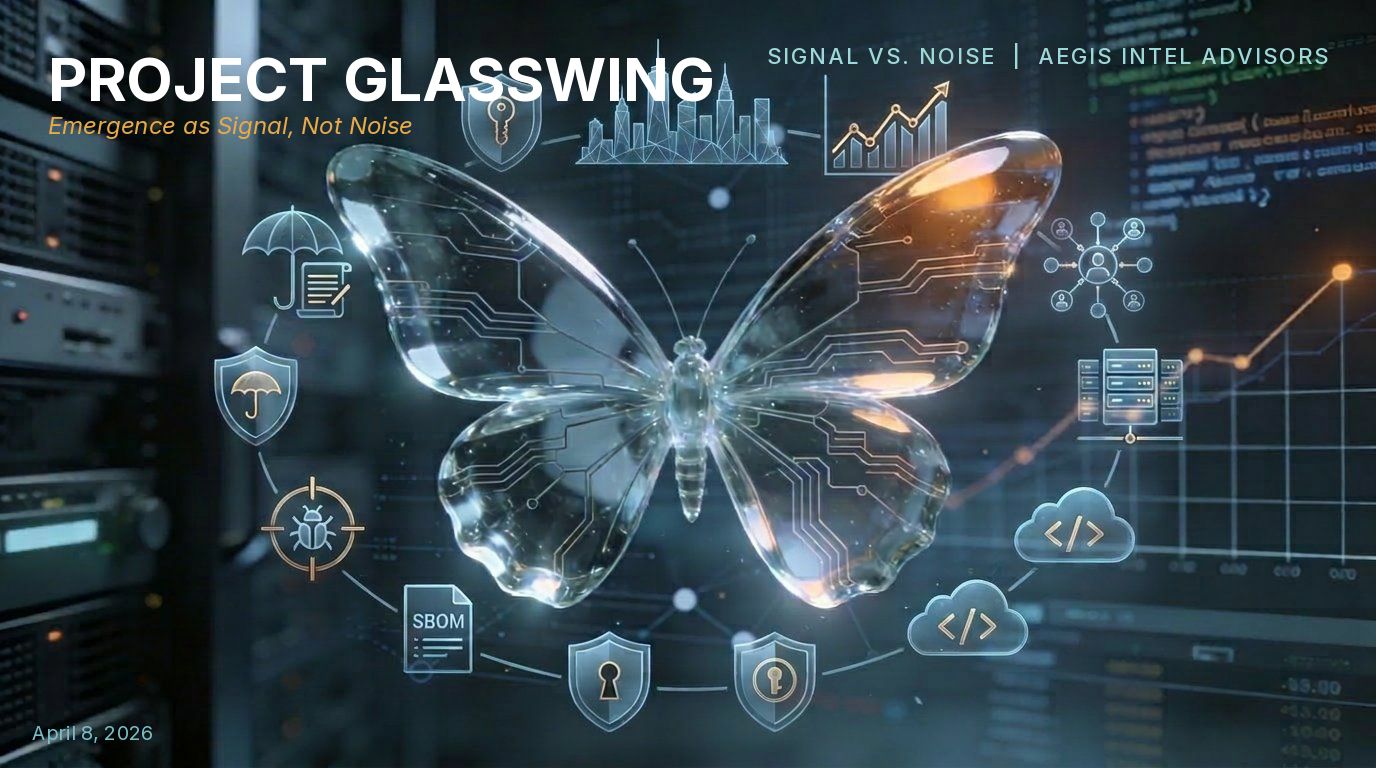
On April 7, 2026, Anthropic announced Project Glasswing and Claude Mythos Preview, a frontier AI model the company says is too dangerous to release broadly because of its capability in finding software security flaws.
Anthropic reported thousands of previously unknown vulnerabilities across major operating systems and web browsers. They created Project Glasswing, a launch plan including $100 million in usage credits across twelve partners — including AWS, Apple, Google, Microsoft, Cisco, CrowdStrike, and the Linux Foundation — and over forty additional critical‑software organizations under restricted access.
The capability claims have not been independently verified or refuted. The question rocking markets and industry is this: if Mythos is what Anthropic says it is — or if similar capability is pending soon at OpenAI or at open‑weight labs — then the impact on global enterprise tech is an open question neither side of the debate is answering.
Anthropic and Adherents
- Market Leaders: Simon Willison, open-source developer and creator of Datasette, has argued that restricting access to Mythos‑class capability is necessary and that the risk is credible, not hypothetical. CEOs at the top two cybersecurity firms in the world — Palo Alto Networks’ Nikesh Arora and George Kurtz of CrowdStrike — described AI as the largest security demand driver since enterprises moved to the public cloud.
- Treasury and Fed Chair Emergency Bank Briefing: Scott Bessent and Jerome Powell pulled the heads of America's biggest banks into a closed-door session on the sidelines of a Washington event to walk through Mythos's capabilities and implications.
Bloomberg and the Financial Times broke the story. If validated, AI cyber risk has been elevated from an IT issue to a systemic financial stability concern. JPMorgan Chase was the only financial institution in the Glasswing coalition — this could either be pre-IPO customer validation, early-stage federal coordination, or both simultaneously.
The Skeptic Camp
However, some leading technology and government thought leaders, with essential topical visibility and credentials, argue just the opposite.
David Sacks — until recently the White House AI Czar and former COO of PayPal — argued on the All‑In podcast on April 10th that Anthropic uses ‘safety framing’ to promote its own products and engineer regulatory capture. Dire proclamations draw attention and infer differentiation to Anthropic's efforts. In his view, the language of “dangerous models” is self-serving to the firm’s market aspirations, as both a go‑to‑market and moat strategy.
This issue is not only on Anthropic's doorstep. AISLE, a cybersecurity research firm, recently published independent work testing vulnerabilities against small, cheap, open‑weight models. The smaller AI models — eight out of eight, in fact — all detected the flagship FreeBSD exploit as Mythos did, and a 5.1‑billion‑parameter open model recovered the core chain of the 27‑year‑old OpenBSD bug Anthropic highlighted. (Notably absent from last week’s dialogue were the recent gaffes by Anthropic around the accidental leakage of their proprietary codebase about two weeks ago).
Glasswing’s Coalition Serves as Pre-IPO Planning. A fourth strand of the skeptic read centers on commercial timing and coalition composition. The Glasswing coalition is not a neutral technical working group. Its twelve named launch partners are concentrated in cloud infrastructure, enterprise hardware, cybersecurity platforms, and — notably — financial services, with JPMorgan Chase the lone bank at the table.
This approach locks the most visible enterprise names into subsidized Anthropic consumption via a $100 million credit pool and brings validation narratives during a pre‑S‑1 window. This positions Anthropic as the reference architecture in sectors most likely to anchor institutional demand for an eventual offering.
Accordingly, at this early stage, the conservative assumption is that Mythos’ capability claims are genuine, while Anthropic is pitching the announcement optimized for the upcoming valuation window. This has occurred repeatedly in the past:
- AGI Existential Risk Positioning (March 2023): Safety branding supports escalating Series C valuation.
- Responsible Scaling Policy (September 2023): First formal frontier lab safety framework.
- Claude 3 Launch (March 2024): Safety-first messaging paired with Series D fundraise.
- Computer Use Disclosure (October 2024): First-mover agentic capability with safety caveats.
- Interpretability Publication Cadence (Early 2025): Research transparency shapes regulatory conversation in Anthropic's favor.
- First AI-Orchestrated Espionage Disclosure (September 2025): Capability warning lands inside Claude 4.5 cycle.
- "90% Chinese Espionage" Disclosure (November 2025): High-stakes claim under Anthropic's narrative control.
- Pentagon Dispute Surfaces (February 2026): Principled federal refusal as commercial differentiation.
Both camps are represented by executives worth taking seriously. But the debate — inflection moment versus overstated marketing — is not the debate that matters.
The Blast Radius in Enterprise Technology
Eventually, Mythos-class capability will arrive and proliferate. If it reaches hostile actors — what actually breaks?
The at-risk tech stack starts with a set of open‑source codebases that sit underneath the majority of global commerce, communications, and critical infrastructure. Linux Foundation and Harvard Census II / III studies estimate that free and open‑source software constitutes roughly 70 to 90 percent of any modern software solution by component count. The ten projects listed below are where the damage concentrates:
- Linux kernel: Runs most of the world’s cloud servers and Android phones.
- OpenSSL: Handles the encryption behind most “https” connections.
- Chromium: The engine inside Chrome, Edge, Brave, and most modern browsers.
- OpenSSH: The standard tool for logging into remote servers.
- systemd: Starts and manages services on most Linux systems.
- glibc: The foundational library nearly every Linux program depends on.
- Apache and nginx: The two web servers delivering a large share of internet pages.
- Log4j: An “invisible” Java logging tool that triggered a White House–level summit during Log4Shell.
- curl: A data‑transfer tool embedded in roughly 20 billion devices.
- Kubernetes: Orchestrates cloud workloads across AWS, Microsoft, and Google.
More insidious and potentially widespread is the Cross‑Tenant Cloud Exposure of the hyperscalers. Mythos‑related technical reporting has highlighted a virtual machine monitor (VMM) guest‑to‑host escape — a flaw that, if real in production, breaks the foundational isolation assumption of every public cloud.
The fact that AWS, Microsoft, Google, and Cisco are all named Glasswing partners is consistent with this being the highest‑priority defensive concern on the coalition’s agenda.
Potential Impact for Institutional Investors
The conservative assumption to make at this early stage is seeing Mythos as both a capability story and an Anthropic valuation story. The blast‑radius potential means this is an overall sector‑exposure story.
Cyber insurance carriers have the most asymmetric exposure on the downside. Underwriting models built on human‑scale threat velocity do not absorb a world in which attacker discovery outpaces defender remediation by an order of magnitude. Carrier‑by‑carrier public posture changes in the next two quarters are the signals worth tracking. Reinsurance pricing is the downstream tell.
Cloud hyperscalers — AWS, Azure, Google Cloud — carry the specific cross‑tenant isolation risks flagged above. A confirmed production VMM escape that reaches public disclosure is a category event, not a company‑specific event, and their market’s current valuations reflect a trivial probability of that outcome within the Glasswing disclosure window.
Legacy enterprise software vendors with exposure to widely deployed but under‑maintained open‑source components carry concentrated patch gap risk. The sectors where this lands hardest are:
- Financial services infrastructure
- Healthcare technology
- Operational technology and critical infrastructure
- Telecom
These are the segments where the patch gap is measured in quarters rather than days, and where a Mythos‑class discovery pipeline meets the thinnest remediation capacity.
Bottom Line
Mythos is real or soon will be, and so will others. Both camps in the current debate are worth hearing, and the skeptic side is admittedly the thinner of the two. The question neither side is answering is what part of the global technology stack collapses if the capability is confirmed and proliferates — and what that means for the institutional capital positioned across the sectors sitting on top of it.
In our next article, we will analyze the blast radius impact of Mythos on the cybersecurity market and its leading players.
Sources
Anthropic Primary Sources
— Anthropic, Project Glasswing: Securing Critical Software for the AI Era, April 7, 2026. https://www.anthropic.com/glasswing
— Anthropic Frontier Red Team, Assessing Claude Mythos Preview's Cybersecurity Capabilities, April 7, 2026. https://red.anthropic.com/2026/mythos-preview/
— Anthropic, Disrupting AI-Orchestrated Cyber Espionage Campaign, November 2025. https://www.anthropic.com/news/disrupting-AI-espionage
Capability Verification & Independent Replication
— AISLE, AI Cybersecurity After Mythos: The Jagged Frontier, April 7, 2026. https://aisle.com/blog/ai-cybersecurity-after-mythos-the-jagged-frontier
— Willison, Simon, Anthropic's Project Glasswing — Restricting Claude Mythos to Security Researchers Sounds Necessary to Me, April 7, 2026. https://simonwillison.net/2026/Apr/7/project-glasswing/
— NPR, How AI Is Getting Better at Finding Security Holes, April 11, 2026. https://www.npr.org/2026/04/11/nx-s1-5778508/anthropic-project-glasswing-ai-cybersecurity-mythos-preview
— Stiennon, Richard, Mythos Preview Is a Break-Glass Moment, IT-Harvest Substack, April 9, 2026. https://stiennon.substack.com/p/mythos-preview-is-a-break-glass-moment
Bessent-Powell Roundtable Coverage
— Bloomberg / Financial Times via TechXplore, After Anthropic's Mythos AI Uncovers Thousands of Zero-Day Bugs, Top US Officials Huddle with Bank CEOs, April 10, 2026. https://techxplore.com/news/2026-04-anthropic-mythos-ai-uncovers-thousands.html
— Lohrmann, Daniel, Why Anthropic's Mythos Is a Systemic Shift for Global Cybersecurity, Security Boulevard / GovTech, April 12, 2026. https://www.govtech.com/blogs/lohrmann-on-cybersecurity/why-anthropics-mythos-is-a-systemic-shift-for-global-cybersecurity
Skeptic Camp & Regulatory Capture Critique
— Sacks, David, All-In Podcast, April 10, 2026. https://www.allinpodcast.co
— Stratechery / Ben Thompson, Anthropic's New Model, The Mythos Wolf, Glasswing and Alignment, April 9, 2026. https://stratechery.com/2026/anthropics-new-model-the-mythos-wolf-glasswing-and-alignment/
— Platformer / Casey Newton, Why Anthropic's New Model Has Cybersecurity Experts Rattled, April 7, 2026. https://www.platformer.news/anthropic-mythos-cybersecurity-risk-experts/
— Picus Security, The Glasswing Paradox: The Thing That Can Break Everything Is Also The Thing That Fixes Everything, April 7, 2026. https://www.picussecurity.com/resource/blog/anthropics-project-glasswing-paradox
Cyber Platform Leadership Commentary
— CrowdStrike / George Kurtz, CrowdStrike: Founding Member of Anthropic's Project Glasswing, April 8, 2026. https://www.crowdstrike.com/en-us/blog/crowdstrike-founding-member-anthropic-mythos-frontier-model-to-secure-ai/
Pre-IPO Context & Commercial Timing
— Fortune, Anthropic Is Giving Some Firms Early Access to Claude Mythos to Bolster Cybersecurity Defenses, April 7, 2026. https://fortune.com/2026/04/07/anthropic-claude-mythos-model-project-glasswing-cybersecurity/
— Fortune, Anthropic's Mythos Is a Wake-Up Call, but Experts Say the Era of AI-Driven Hacking Is Already Here, April 10, 2026. https://fortune.com/2026/04/10/anthropic-mythos-ai-driven-cybersecurity-risks-already-here/
— Latent Space, AI News: Anthropic $30B ARR, Project Glasswing, April 8, 2026. https://www.latent.space/p/ainews-anthropic-30b-arr-project
— TechCrunch, Anthropic Debuts Preview of Powerful New AI Model Mythos in New Cybersecurity Initiative, April 7, 2026. https://techcrunch.com/2026/04/07/anthropic-mythos-ai-model-preview-security/
— NBC News, Anthropic Project Glasswing: Mythos Preview Gets Limited Release, April 8, 2026. https://www.nbcnews.com/tech/security/anthropic-project-glasswing-mythos-preview-claude-gets-limited-release-rcna267234
Open Source Software Footprint
— Linux Foundation / Harvard Laboratory for Innovation Science, Census II of Free and Open Source Software — Application Libraries, 2022. https://www.linuxfoundation.org/research/census-ii-of-free-and-open-source-software-application-libraries
— Linux Foundation / Harvard Laboratory for Innovation Science, Census III of Free and Open Source Software, 2024. https://www.linuxfoundation.org/research/census-iii
Regulatory and Policy Context
— Reuters, US Judge to Weigh Anthropic's Bid to Undo Pentagon Blacklisting, March 24, 2026. https://www.reuters.com/legal/government/us-judge-weigh-anthropics-bid-undo-pentagon-blacklisting-2026-03-24/
— Nextgov, Anthropic's Glasswing Initiative Raises Questions for US Cyber Operations, April 2026. https://www.nextgov.com/cybersecurity/2026/04/anthropics-glasswing-initiative-raises-questions-us-cyber-operations/412721/