
Anthropic Shipped a Code Scanner. Wall Street Heard Something Else.
Key Takeaways
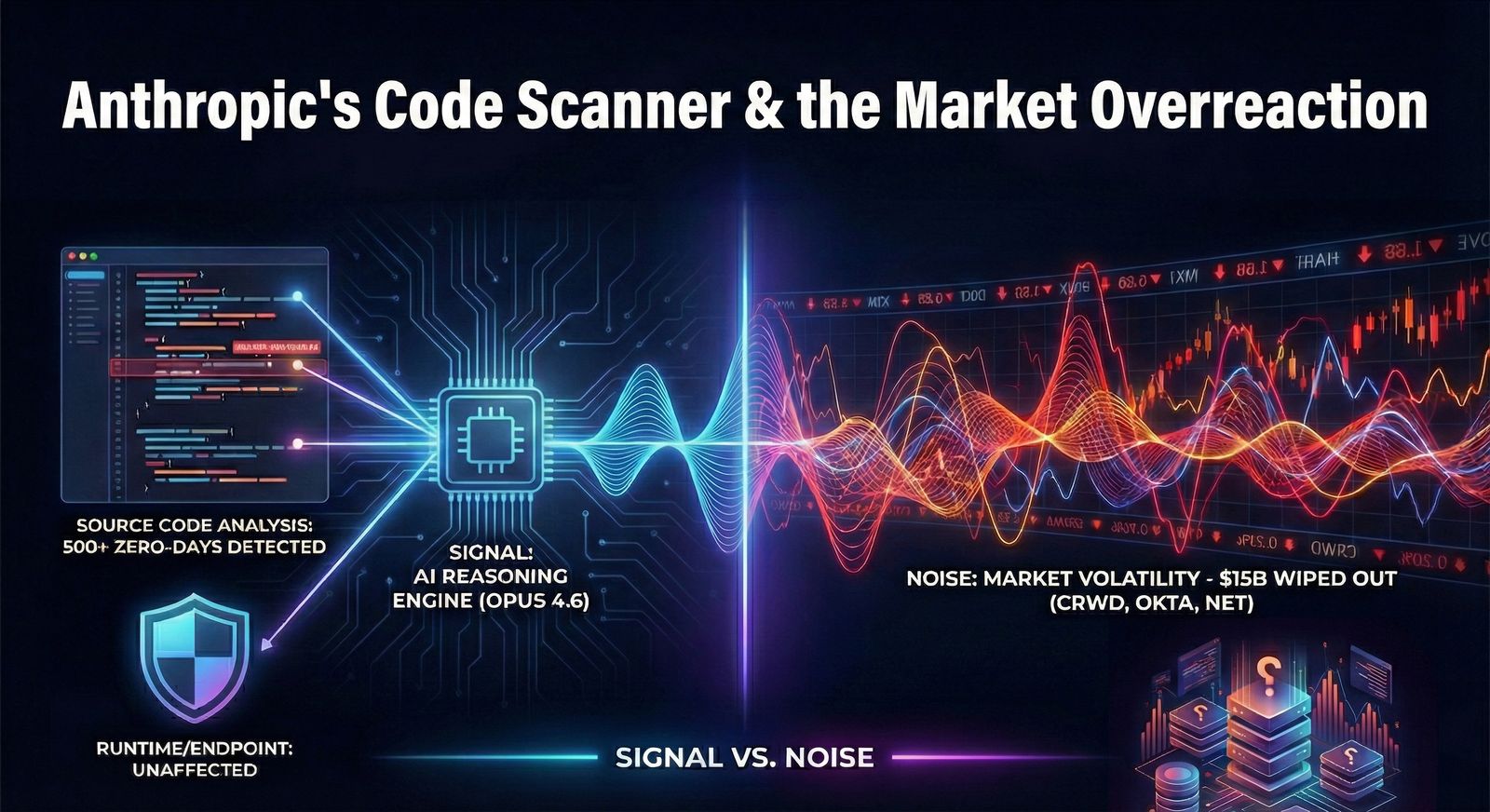
The Signal: Reasoning-based AI scanning is a legitimate structural shift. With Opus 4.6 uncovering 500+ zero-days in legacy open-source projects, traditional SAST and manual pen-testing face direct pressure.
The Noise: The indiscriminate selloff of CrowdStrike, Okta, and Cloudflare. Claude Code Security is a point solution for developers. It does not monitor endpoints, manage identities, or enforce zero-trust. Wall Street repriced the entire stack over a tool that does not touch the other 90% of enterprise security.
For CISOs, the real challenge is not replacing EDR — it is the governance surface of deploying an agentic platform with read/write access to codebases and operational systems.
The Model Behind the Scanner
Before examining what Anthropic shipped on February 20 and why the market reacted the way it did, it is worth understanding the model that powers it. Claude Opus 4.6, released February 5, represents a step change in what frontier AI systems can do in the cybersecurity domain. The evidence is specific and verifiable.
Anthropic’s Frontier Red Team pointed Opus 4.6 at production open-source codebases and reported more than 500 validated high-severity zero-day vulnerabilities in projects including Ghostscript, OpenSC, and CGIF. These are codebases that had survived decades of expert review and millions of hours of automated fuzzing. Separately, the model saturated Cybench at approximately 100% on pass@30, prompting Anthropic to acknowledge that current benchmarks can no longer track capability progression. On the newer CyberGym benchmark, Opus 4.6 scored 66.6% at pass@1, up from 51.0% for Opus 4.5 and 29.8% for Sonnet 4.5.
In a parallel experiment, Anthropic researcher Nicholas Carlini deployed 16 Opus 4.6 instances working autonomously — no human writing code, no internet access, no central orchestrator. Over two weeks and approximately $20,000 in compute, those agents produced a functional C compiler: more than 100,000 lines of code capable of building the Linux kernel, PostgreSQL, and over 150 additional production software packages.
Accelerating Curve
Twelve months ago, autonomous AI coding sustained coherence for roughly 30 minutes before losing the thread. Last summer, seven hours was considered extraordinary. Now: two weeks. Carlini himself noted: “I did not expect this to be anywhere near possible so early in 2026.”
That is the model Anthropic then productized. Fifteen days after publishing the zero-day research, they shipped Claude Code Security. What followed in the market was instructive, but not for the reasons most commentary suggests.
What Anthropic Actually Built
Claude Code Security is a reasoning-based code vulnerability scanner built into the existing Claude Code development environment. It is available as a limited research preview for Enterprise and Team customers, with expedited access for open-source maintainers. It scans codebases for vulnerabilities, applies multi-stage verification to filter false positives, and surfaces validated findings with suggested patches. Human approval is required for every fix. Nothing deploys without explicit sign-off.
The technical approach is genuine. Traditional static application security testing (SAST) tools compare code against known vulnerability signatures. Claude Code Security reasons about code intent, data flows, and business logic to identify vulnerabilities that pattern-matching tools structurally miss. This is a legitimate advance in application security. It is also a point solution in a single domain.
What the Market Did
Within 72 hours of the announcement, the cybersecurity sector lost more than $15 billion in market capitalization. CrowdStrike dropped 17% over two trading days. Cloudflare fell 8%. Okta declined 9%. SailPoint shed 9.4%. The Global X Cybersecurity ETF (BUG) fell to its lowest level since November 2023. The iShares Expanded Tech-Software Sector ETF has now lost approximately 23% year-to-date.
The selloff was indiscriminate. CrowdStrike operates at the endpoint runtime layer: behavioral monitoring, threat intelligence, zero-trust enforcement, and lateral movement detection. Okta manages identity. Zscaler provides network security. None of these have product overlap with a source code vulnerability scanner. Investors sold across the entire sector classification without distinguishing between application security and the other 90% of the cybersecurity stack.
A Crowded Field the Market Missed
Anthropic is not the first or only entrant in AI-native code security. Six AI-native players now operate in this space: Anthropic (Opus 4.6, 500+ zero-days claimed), OpenAI (GPT-5/Aardvark with sandbox validation, private beta), Google (Gemini Deep Think with multi-agent scanner/debugger/critic/fixer, 72 upstream fixes merged), AISLE (full-loop Cyber Reasoning System, 100+ CVEs, 12 of 12 OpenSSL January 2026 CVEs discovered), XBOW ($117 million raised, 1,400+ zero-days, HackerOne number one ranking, fully autonomous), and Microsoft (Security Copilot plus agent swarm across Defender, Intune, Entra, and GitHub, bundled into E5).
Four incumbent SAST vendors are actively adapting: Snyk (developer workflow integration, discovered malicious AI agent skills on ClawHub in January 2026), Semgrep (LLM-augmented rules, CEO publicly demanding false positive rate transparency from all entrants), Checkmarx (CxOne AI engine), and StackHawk (MCP Server integration providing runtime DAST testing inside Claude Code, Cursor, and Windsurf).
No vendor in this field publishes false positive rates. Semgrep CEO Isaac Evans has called this out directly. Security researchers have also noted that not all of Anthropic’s 500 vulnerabilities are as high-severity as described. Without false positive data, every benchmark in this market is a marketing number.
Where Impact Is Real
Static penetration testing faces the most direct pressure. Standalone SAST tool spend faces compression over the next 12 to 18 months as AI-native scanning commoditizes pattern-matching. Manual penetration testing engagements face cycle-time pressure, with XBOW delivering on-demand results in five days versus 35 to 100 day traditional cycles. AppSec point solutions lose relevance as AI scanning gets bundled into development platforms.
Static application security testing and manual pen testing just had their impact moment — but the blast radius is far more limited than Wall Street recognized. This pattern is increasingly visible across industries which Anthropic has entered since Q4 2025. These are legitimate structural shifts, affecting vendors like Checkmarx and Fortify, along with the economics of traditional pen-testing firms.
Where Impact Is Not
Claude Code Security does not perform runtime testing. It does not send requests through API stacks, test authentication middleware, or confirm whether a finding is exploitable in a running environment. It does not monitor endpoints for active threats, manage identities, segment networks, detect lateral movement, enforce cloud security posture, or run a SOC.
Endpoint detection and response, network security, cloud security posture management, identity and access management, and security operations are entirely outside the scope of what Anthropic built. Budget categories in these domains remain flat. Meanwhile, AI governance tooling, runtime security (DAST), identity management, and AI-specific threat detection remain potential growth categories. The net effect on enterprise security budgets is most likely expansion, not contraction.
CrowdStrike CEO George Kurtz underscored this by asking Claude directly whether Claude Code Security could replace what CrowdStrike does. Claude said no. Snyk CEO Peter McKay reframed the conversation: finding vulnerabilities has never been the hard part; fixing them at speed, in the developer workflow, at scale is where value accrues. StackHawk is aggressively exposing the SAST-DAST boundary, noting that Anthropic’s examples resemble dataflow and memory analysis rather than true business logic testing.
Separating Signal from Noise
The signal: reasoning-based code scanning is a genuine technical advance. All four foundation model companies now have code security tools. This is a confirmed category, not a feature. AISLE and XBOW provide independent proof that AI-native security delivers validated results.
The noise: a code-scanning tool was priced as a platform-level disruption across domains it does not touch. The selloff hit companies whose products have zero overlap with source code analysis.
For CISOs evaluating Claude Code Security, the product question is straightforward. The governance question is harder: deploying a reasoning-based scanner means deploying an agentic platform with read access to codebases, write access to operational systems, event-driven hooks, and parallel subagent execution.
Most organizations have not scoped this surface yet. That gap between the technology’s arrival and the governance frameworks to manage it is the risk worth watching. Sources 1. Anthropic, "Introducing Claude Opus 4.6," February 5, 2026. anthropic.com/news/claude-opus-4-6 2. Carlini, N., "Building a C compiler with a team of parallel Claudes," Anthropic Engineering Blog, February 5, 2026. anthropic.com/engineering/claude-c-compiler 3. Anthropic Frontier Red Team, "0-Days," February 5, 2026. red.anthropic.com 4. Anthropic, "Claude Code Security," February 20, 2026. anthropic.com/news/claude-code-security 5. Bloomberg, "Anthropic Unveils 'Claude Code Security,' Sending Cyber Stocks Lower," February 20, 2026. 6. CNBC, "Cybersecurity stocks drop for a second day as new Anthropic tool fuels AI disruption fears," February 23, 2026. 7. Duprey, R., "Anthropic Mauls CrowdStrike Again. Here's Why the Cybersecurity Stock Is a Buy," Money Morning, February 25, 2026. 8. The Register, "Infosec community panics over Anthropic Claude Code Security," February 23, 2026. 9. VentureBeat, "Anthropic's Claude Code Security is available now after finding 500+ vulnerabilities: how security leaders should respond," February 23, 2026. 10. Fort, S., "What AI Security Research Looks Like When It Works," AISLE, January 27, 2026. aisle.com/blog 11. Fort, S., "AI found 12 of 12 OpenSSL zero-days (while curl cancelled its bug-bounty)," LessWrong, January 27, 2026. 12. XBOW, "Taking the Top Hacker in the US to New Heights: XBOW Raises $75M Series B," June 24, 2025. xbow.com/blog/series-b 13. CSO Online, "Anthropic's Claude Code Security rollout is an industry wakeup call," February 23, 2026. 14. Ashley, M., "Claude Found 500 Zero-Days. Who Patches Them Before Attackers Arrive?" Futurum Group, February 25, 2026. 15. Cortex, "2026 Engineering Benchmark," 2026. cortex.io